How to Help Gorillas: What Actually Works
Gorillas are the largest of the great apes, and they are in serious trouble. Both species, the western gorilla and the eastern gorilla, are listed as Critically Endangered on the IUCN Red List. But there is also one of the best comeback stories in conservation hidden in the gorilla family. Here is what is going wrong, what has worked, and how you can help gorillas from wherever you live.
Meet the gorillas
There are two gorilla species, and each has a lowland and an upland subspecies, according to WWF. They live in the forests of equatorial Africa, separated by about 560 miles (around 900 km) of Congo Basin forest.
- Western gorillas include the western lowland gorilla and the Cross River gorilla.
- Eastern gorillas include the mountain gorilla and Grauer’s gorilla, also called the eastern lowland gorilla.
Gorillas live in family groups led by a dominant adult male, the silverback. They are mainly vegetarian, eating stems, bamboo shoots and fruit. As they move and feed, they spread seeds and open gaps in the canopy that let light reach the forest floor, so they help keep their forests healthy (WWF).
One detail explains why gorillas struggle to recover: a female usually gives birth to just one baby every four to six years, and only three or four over her whole life. Even small losses take a long time to make up.
Why gorillas are Critically Endangered
Hunting and snares
WWF calls the commercial bushmeat trade in West and Central Africa a significant and constant threat. Gorillas are also killed or maimed by wire snares set for other animals (WWF).
Habitat loss
Forests are cleared for farming, cut up by logging and roads, or replaced by settlements. WWF notes that only about 22% of western lowland gorillas live in protected areas, and that logging roads give hunters access to forests that used to be out of reach.
Disease
Ebola has devastated great ape populations. Scientists estimated in 2003 that a third of the wild gorilla population had been killed by the virus. Because gorillas are so closely related to us, they can also catch human illnesses, including respiratory infections (WWF).
Mining and conflict
In eastern Democratic Republic of Congo, Grauer’s gorillas fell by an estimated 77% in about 20 years, from around 17,000 in 1995 to 3,800, according to the Wildlife Conservation Society. The study behind those numbers, published in PLOS One, links the decline to civil war and hunting. WCS points to the spread of small, remote mining sites for coltan, a mineral used in phones and electronics, where miners often hunt wildlife for food.
The good news: mountain gorillas are recovering
In November 2018, the IUCN moved the mountain gorilla from Critically Endangered to Endangered. The population had grown from around 680 in 2008 to over 1,000, the highest figure ever recorded for the subspecies. A combined count published in 2019 put the global number at 1,063 (WWF).
What made the difference? The IUCN credits:
- Anti-poaching patrols and the removal of snares.
- Veterinary care in the field, treating sick and injured gorillas where they live.
- Cooperation across borders, since mountain gorillas live where Uganda, Rwanda and the Democratic Republic of Congo meet.
- Communities living around the parks taking part in protecting them.
Well managed tourism helps pay for much of this. WWF says the money earned from gorilla tourism funds the parks and supports local and national economies.
The wider eastern gorilla species is still Critically Endangered, so this is a recovery in progress, not a finished job. But it proves that steady, well funded protection works.
How to help gorillas: practical steps
You probably won’t meet a wild gorilla this year. You can still make a difference.
- Recycle your old phone. Phones contain minerals such as coltan, and mining for it has fuelled hunting in Grauer’s gorilla habitat. Recycling old devices reduces the demand for newly mined minerals (Mongabay). Ask brands where their minerals come from, too.
- Choose FSC certified wood and paper. WWF supports Forest Stewardship Council certification in the Congo Basin, and cites a 2024 study in Nature that found more medium and large mammals in FSC certified forests in Gabon and the Republic of Congo than in uncertified ones.
- If you go trekking, follow the health rules. The IUCN great ape guidelines ask visitors to stay at least 7 metres away, wear a mask correctly and not visit at all when feeling ill. Visits are usually limited to one hour.
- Support anti-poaching and community work. Patrols, snare removal and local jobs are what turned the mountain gorilla story around.
- Share the story. Most people have no idea that gorillas are Critically Endangered, or that one subspecies is recovering. Talking about it builds support.
Wear the reminder
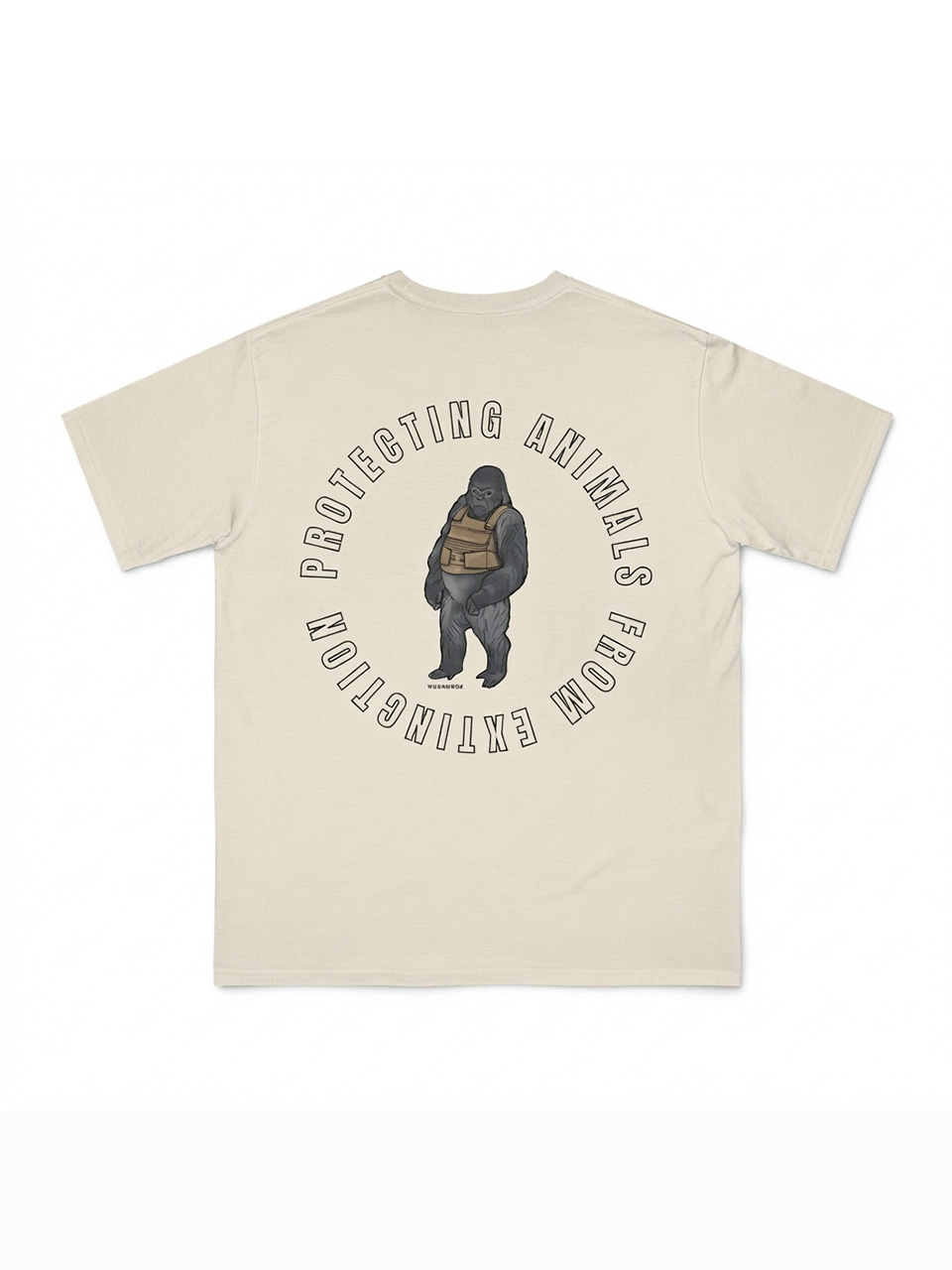
Our Gorilla tee comes in two colours: Natural and deep Pacific. Both carry a gorilla on the back inside the words “Protecting Animals From Extinction”, with a small Ndangrdz logo on the chest. They are made from 100% certified organic, ring-spun cotton, and 10% of profit goes to protecting endangered animals. When someone asks about the gorilla, tell them about the mountain gorillas that came back.
FAQ
Are gorillas endangered?
Yes. Both the western and the eastern gorilla are Critically Endangered on the IUCN Red List. The mountain gorilla, a subspecies of the eastern gorilla, was moved to Endangered in 2018 because its numbers grew (IUCN).
What is the biggest threat to gorillas?
Hunting for bushmeat, habitat loss and disease, especially Ebola. WWF names Ebola as most likely the biggest threat.
How many mountain gorillas are left?
The combined count published in 2019 was 1,063 (WWF). A new census of Bwindi was carried out in 2025, so this number may be updated.
Does recycling my phone really help gorillas?
It helps reduce demand for newly mined minerals like coltan, whose mining has been linked to gorilla hunting in eastern Democratic Republic of Congo. It works best alongside protection on the ground.
How much DNA do we share with gorillas?
About 98.3%, which makes gorillas our closest cousins after chimpanzees and bonobos (WWF).
Sources
All checked and resolving on 17 Nov 2026:
- IUCN Red List, Gorilla gorilla
- IUCN press release, mountain gorilla moved to Endangered (14 Nov 2018)
- WWF, Gorillas
- WWF, Global mountain gorilla population count grows to 1,063
- WCS, Grauer’s gorilla report
- PLOS One, Plumptre et al. 2016
- Mongabay, phone recycling and gorillas
- IUCN SSC Primate Specialist Group, Protect great apes from disease